#40days40books entry 31
This entry is labeled #will someone ever write a bookseller I recognize
Because I have yet to watch a movie, and rarely to read a book that features a bookseller doing a job that I recognize as the job(s) I have had selling books. In point of fact, I've not see someone I know who sells books, either.
Aaliya Saleh of An Unnecessary Woman is the person I most recognize as a bookseller. She is compulsively surrounded by books and lives in them in a personal but distant way. She works hard and walks a ton. Her relationship to the written word is lively but not arrogant.
I tend to cringe at novels featuring booksellers. They tend to be emotionally deficient, reading all the time, and never seem to do much actual work. Books magically shelve themselves (?) and no one ever has to negotiate this ridiculous conversation: "Oh, I'd love to be a bookseller! Just to read all day, how wonderful!" the person says as you have just spent 10 minutes with them clearly not engaged in the act of reading.
Listen. It's a good job. The work is solidly demanding and fulfilling. Books are great and readers tend to speak a secret language to each other that is really wholesome for the introverts that bookstores tend to hire.
And we work. Boxes of books are heavy and must be lifted. Questions of shelving are thorny and must be answered.
Give me a television show about a community made of stores in a strip mall trying to get out of some edge of town hell-mouth and into a derelict building just off the town square - give me the weird politics and social justice issues of local economics. I want to see someone struggle with the decision to keep selling their crafts on-line or throwing in with other folks and setting up as a brick-and-mortar.
Put Kim Fields in charge of the city council, Alison Janney on whatever fence she chooses, and because she's (obvi) the cool garden shop lady, there are a bunch of folks who are waiting for her to make up her damn mind until bffs Traci Ellis-Ross (architect) and Sandra Oh (ecologist) have coffee with bookstore owner and over-worked genius Andrea Navedo whereat they all pick their flags and their sides and Season One ends with a City Council meeting after the old building has been acquired and the city has decided to back the rehab. Season Two is all about the contractors and Season Three follows the first year of residence. Through it all are conversations between folks about the need to shop locally, how to run a business, how to be friends in business with each other. We see mistakes and learning and specificity and loss and the booksellers shelve books. They take inventory. They struggle with figuring out how to deal with a shoplifter in the strip mall. They learn new layouts of stores. They find themselves in constant combat with publishers and distributors and do-gooder community members. You know. Like real damn people living in a world whose global online economy is turning into a malignant tumor.
I know that there was a time when bookselling was not the same as working retail. I know that there are bookstores where that is, in many ways, still true. But that is not my experience and it is not the experience of many people of my acquaintance. If we took the gentility out of the expectation, I think, maybe, our stories could be vital rather than reassuringly old-fashioned.
#40days40books list
Friday, October 21, 2016

Wednesday, October 19, 2016
Women and their barricades
#40days40books entry 30
An Unnecessary Woman by Rabin Alameddine follows the story of Aaliya Saleh, a 72 yeard old retired bookseller living in Beirut. She is a single, childless women living alone in her apartment. The book opens with her drunk on New Year's Eve having accidentally dyed her hair blue. Her memories span marriage, divorce, conflict, struggle, loneliness and now old age. It is compassionate, funny, brutal and deeply affirming. I have a lot of love for Aaliya. She is kindred in many ways.
A General Theory of Oblivion by Jose Eduardo Agualusa is a novelized account of a women who, in real life, bricked herself into her brother-in-law's apartment during Angola's successful bid for independence from Portugal. She lived there for 28 years. The novel follows many other people from that day to the present, and, like many war stories, addresses the complications of survival and success and how those are measured differently. Ludovico wrote on the walls with charcoal when she ran out of books to write in. She burned books for fuel. She trapped pigeons for food. Her success at living behind her bricked wall is nothing short of tremendous.
Pond by Claire-Louise Bennett is a novel that follows an unnamed woman living in mostly solitude around her life for several months, perhaps a year. There is very little that is concrete in this book. It is an internal monologue that veers from absurd and delightful to cringe-worthy in the space of a sentence. The woman is not much in company and deeply uncomfortable after. She lives with the constant threat of depression, a reality that is finally and troublingly manifested in toward the end of the book.
Eggshells by Caitriona Lally (not yet published, look for it in February of 2017) is about a young woman called Vivian who has moved into her dead great-aunt's house in Dublin and who sets about ordering her life according to her own terms entirely. She's decided she needs a friends called Penelope, puts up signs advertising for her and then is somewhat surprised when Penelope calls and they begin a gentle friendship. Viv walks the streets of Dublin regularly and each chapter has a line drawing of the shape of her journey.
Every woman in these books has deliberately barricaded herself from the world. Sometimes that choice is made easier by mental illness or war or the inertia of circumstance. That said, they all survive, and do so pretty well. There are no tragedies here, no grand passionate outbursts or despairing destruction.
It's something I'd like to write more about, because the type of woman who generally is seen on her own is a woman who has become somehow violent or stronger. She is Circe, plotting and planning and cursing men, rather than Penelope who ran a kingdom for 20 years in the absence of her husband. I love Penelope. She made the choice to live behind the wall of her marriage and her bedroom rather than join attempts to marry her off. She made that choice. And she did well there. Ultimately, all of these women (all of them) are brought back into the world by a community or the love of a friend.
There have to be more of these women. There just have to be. Someday I'd like to find their stories, because they are so moving.
Also I should like to more carefully define what I mean by self-barricaded so that I can have that folder in my critical analysis brain for future reading.
#40days40books list
Monday, October 17, 2016
How to Suppress Women's Writing by Joanna Russ
Another book from 1983. How to Suppress Women's Writing by Joanna Russ is a scathing tutorial in systemic sexism. The book is broken up into chapters that address many of the statements seen on the cover and their overall power to erase women from the narratives of publication and existence.
The writing is clear and undecorated, and the citations are rich and varied. The last chapter, particularly, is filled with projects and writers working to bring the work of women of color back into focus. The sting of satire here is pretty strong.
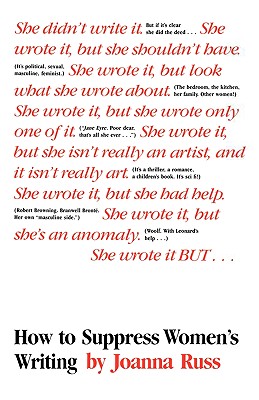
Probably this had a more profound effect on me because I am a writer, and so closely identify with the work that is here discussed. Representation matters. Sadly, every profession in which women have participated has a story that is similar, and everything that is listed in this book is that much more pronounced when the women writing are in any way marginalized.
Have you ever noticed that as soon as someone finds out that one woman was involved in a project whose public face was all men, there are suddenly two or three or twenty more? This book challenges me to look harder at who was writing when, and also I maybe decided to not read men during 2016 (except for reading groups, because duh) and that may have been one of the best reading decisions I made since I rediscovered children's picture books.
#40days40books list
Sunday, October 16, 2016
Angela Davis takes us to school
#40days40books entry 28
Angela Davis's 1983 book Women, Race & Class is a masterwork of cultural commentary. Davis tracks the Women's Movement from its earliest days chronicling the involvement and contributions of Black Women and the frequently dismissive and racist attitudes White Women held toward them, but not their work.
The book is fast-moving and filled with citations from a bibliography that would make any library jealous. Speeches, letters, prison records all contribute to give more texture to a story that many of us are only barely taught, if at all. Here are examples of women working to better the entire world and women working to improve only a very small, very white section of that world.
I cannot emphasize the importance of this book enough. It should be required reading for anyone in these here United States of America.
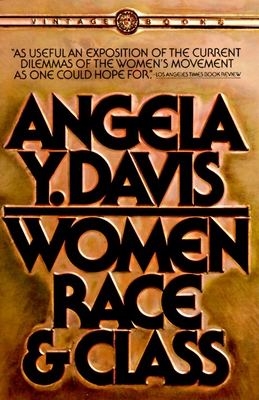
White ladies who are feminists frequently fall into traps of white feminism (they get racist). This book is a lifetime's worth of history about how and why that happens. Not the racism part, that's the part about living in a society that denegrates all non-white people in order to extend specific privileges to white people and everything that entails. No. This is about the role of racism and classism in the Women's Movement.
Davis's writing is so sharp and fast - her examples and citations come thick and fast. She is a thorough researcher and excellent writer. It is not possible (or desirable) to hide your critical awareness in the craft of this work, and it is something she uses to good effect. While I will have to read it again to have a better grasp of the relationships of the people involved, the network of privilege and its corrosive effects on social justice movements is absolutely secure in my thinking.
It is a simple thing to be a White Woman claiming that being empowered as a women helps raise the bar for all women. It is also an egregious and deadly lie. Davis does not, in this book, ask for guilt or shame. She offers questions about complicity and ambition instead. Her work is pointed and purposeful. It is troubling and necessary.
This book is what I measure my decisions against - this is where I go when I have questions about how to feminist while white. Or, more accurately, how Not to feminist while white.
It's short. Shouldn't take long. Will change everything. Go for it.
#40days40books list
Angela Davis's 1983 book Women, Race & Class is a masterwork of cultural commentary. Davis tracks the Women's Movement from its earliest days chronicling the involvement and contributions of Black Women and the frequently dismissive and racist attitudes White Women held toward them, but not their work.
The book is fast-moving and filled with citations from a bibliography that would make any library jealous. Speeches, letters, prison records all contribute to give more texture to a story that many of us are only barely taught, if at all. Here are examples of women working to better the entire world and women working to improve only a very small, very white section of that world.
I cannot emphasize the importance of this book enough. It should be required reading for anyone in these here United States of America.
White ladies who are feminists frequently fall into traps of white feminism (they get racist). This book is a lifetime's worth of history about how and why that happens. Not the racism part, that's the part about living in a society that denegrates all non-white people in order to extend specific privileges to white people and everything that entails. No. This is about the role of racism and classism in the Women's Movement.
Davis's writing is so sharp and fast - her examples and citations come thick and fast. She is a thorough researcher and excellent writer. It is not possible (or desirable) to hide your critical awareness in the craft of this work, and it is something she uses to good effect. While I will have to read it again to have a better grasp of the relationships of the people involved, the network of privilege and its corrosive effects on social justice movements is absolutely secure in my thinking.
It is a simple thing to be a White Woman claiming that being empowered as a women helps raise the bar for all women. It is also an egregious and deadly lie. Davis does not, in this book, ask for guilt or shame. She offers questions about complicity and ambition instead. Her work is pointed and purposeful. It is troubling and necessary.
This book is what I measure my decisions against - this is where I go when I have questions about how to feminist while white. Or, more accurately, how Not to feminist while white.
It's short. Shouldn't take long. Will change everything. Go for it.
#40days40books list
The Marys Wollstonecraft and Shelley
#40days40books entry 27
Romantic Outlaws by Charlotte Gordon is a dual biography of Mary Wollstonecraft and her daughter Mary Shelley. Wollstonecraft died ten days after Shelley was born, and this is the first biography to treat their relationship, distant as it was, as a viable force in the lives of both women.
Gordon contends that Wollstonecraft spent much of her writing life thinking about how to make the world better for girls and women. She developed curriculum to teach young women so that they could become full humans and not simply reproductive members of society. Mary Shelley lived in the pages of her mother's writing, never not aware of her importance or of the extraordinary expectations people placed on her intellect and behavior because both of her parents were radical philosophers of one kind or another.
The book's structure follows each woman through the same ages of their lives in alternating chapters, which steeps the reader in the ebb and flow of obstacle and understanding that was such an important part of both women's lives. It is an absolute treasure and enlightening reading.
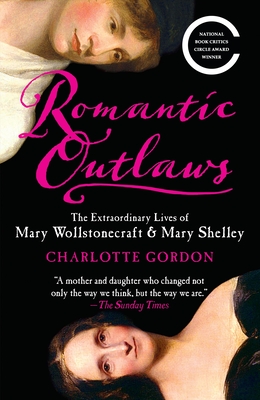
This is a book that I picked up because of the title, to be honest, and just never put back down. I'd read Joanna Russ's brilliant skewering of patriarchal publishing How to Suppress Women's Writing and was ready to learn and ready to be furious at the silencing of so many women's voices over the last 200 years, much less the millennia that came before.
Both women railed against institutionalized sexism in philosophy and fiction. Both women were keenly aware of their relative (but Not total) uniqueness as women in letters. They thought about each other constantly - equally unknown, almost entirely unknowable. There were many times that I had to put the book down and take a deep breath to plunge back in to the terrible waters of blatant male privilege.
I loved it. Charlotte Gordon did an event at the bookstore when the hardcover was released and it was a pleasure to meet her and chat about the role of love in Wollstonecraft and Shelley's writing lives and frameworks.
Added to the bookshelf: Frankenstein by Mary Shelley, Letters Written in Sweden, Norway and Denmark and Maria by Mary Wollstonecraft. I already had A Vindication of the Rights of Women and still haven't finished it on account of constantly feeling the need to put the thing in the freezer.
#40days40books list
Romantic Outlaws by Charlotte Gordon is a dual biography of Mary Wollstonecraft and her daughter Mary Shelley. Wollstonecraft died ten days after Shelley was born, and this is the first biography to treat their relationship, distant as it was, as a viable force in the lives of both women.
Gordon contends that Wollstonecraft spent much of her writing life thinking about how to make the world better for girls and women. She developed curriculum to teach young women so that they could become full humans and not simply reproductive members of society. Mary Shelley lived in the pages of her mother's writing, never not aware of her importance or of the extraordinary expectations people placed on her intellect and behavior because both of her parents were radical philosophers of one kind or another.
The book's structure follows each woman through the same ages of their lives in alternating chapters, which steeps the reader in the ebb and flow of obstacle and understanding that was such an important part of both women's lives. It is an absolute treasure and enlightening reading.
This is a book that I picked up because of the title, to be honest, and just never put back down. I'd read Joanna Russ's brilliant skewering of patriarchal publishing How to Suppress Women's Writing and was ready to learn and ready to be furious at the silencing of so many women's voices over the last 200 years, much less the millennia that came before.
Both women railed against institutionalized sexism in philosophy and fiction. Both women were keenly aware of their relative (but Not total) uniqueness as women in letters. They thought about each other constantly - equally unknown, almost entirely unknowable. There were many times that I had to put the book down and take a deep breath to plunge back in to the terrible waters of blatant male privilege.
I loved it. Charlotte Gordon did an event at the bookstore when the hardcover was released and it was a pleasure to meet her and chat about the role of love in Wollstonecraft and Shelley's writing lives and frameworks.
Added to the bookshelf: Frankenstein by Mary Shelley, Letters Written in Sweden, Norway and Denmark and Maria by Mary Wollstonecraft. I already had A Vindication of the Rights of Women and still haven't finished it on account of constantly feeling the need to put the thing in the freezer.
#40days40books list
Friday, October 14, 2016
Love, InshAllah and the power of possibility
Love, InshAllah is a collection of stories by American Muslim Women talking about love and their love lives. The book and website are a wealth of wonderful writing about every aspect of loving relationships.
Here are stories of lost and found love, unexpected love, unrequited love, that one guy who was a terrible idea but oh well love - all of it. The women are from all over the country and world and their stories are in no way same from one to the next. They share labels and it is in the context of those labels that this collection finds its connections. It is well edited, well organized and engaging.
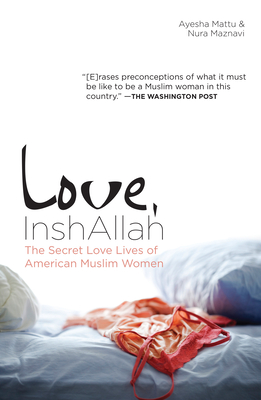
I'd learned about the website (which is wonderful and which should be required reading at least once a week) from the podcast Good Muslim Bad Muslim with Taz Ahmed and Zara Noorbakhsh (both are anthologized in this book). The podcast is produced monthly and is incredible and everyone should listen to it.
Love stories are important. Not the force fed ones with terrible gender politics and classism and racism, etc. and ad stupididem. The ones that we tell each other about our own lives - how many of us know the stories of how our parents met, how Stephen Colbert met his wife, that one time when you just stopped breathing because someone walked in the room. We fall in love. We love our friends. We love our families. We love our cities and our gardens and the furry/feathered ones who live in our houses. Love is daily. We tell its stories because it is our stories.
This collection reminded me.
#40days40books list
Thursday, October 13, 2016
Between the World and Me does not need my introduction
Between the World and Me from Ta-Nehisi Coates is a letter written to his son that is a monologue about what it means to be a Black man in America. Coates talks about his education, his professional and personal decisions and his responses to the world. He also relates stories of public expressions of racism that his son was present for, but may have missed or remembered differently because of his age.
It is not an easy book. Open it anywhere and there are hard words and uncomfortable truths from someone who is seemingly forever sharing hard words and uncomfortable truths.
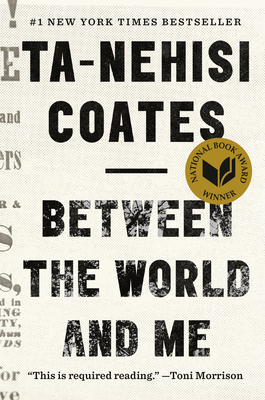
Honestly, if you are reading this blog, you already know about this book. I have nothing of meaning to add, so will offer instead a couple of links.
Ta-Nehisi Coates on Another Round
The Year of Black Memoir by Imani Perry for Public Books
A Matter of Words by Jarek Steele (in response to BLM signs and white privilege)
Also, if you get the chance to listen to the audio book, I recommend it. Reading the words after will be even more of a gut punch, but it is incredible to hear Coates speak his words to 'you' who is, in my case, definitely not 'me.'
#40days40books list
Subscribe to:
Posts (Atom)