Sunday, September 25, 2016

8) A Time of Gifts by Patrick Leigh Fermor

On December 8, 1933, Patrick Leigh Fermor set out on a journey that took him from The Hook of Holland to Istanbul. On foot. For eighteen months. He left England when he was eighteen. The first edition of A Time of Gifts, the first of the book chronicling this journey, was published in 1977, the second in 1986 and the third, built from his notes, posthumously in 2013.

There is no other work that I have read that compares to this. It holds an utterly unique place in the world of letters, even though young men walking away from England is not all that unusual, nor was it at the time. Partly it is Fermor's transformation from a relatively gauche teenager in a world that demanded diplomacy and tact, to a young man accustomed to change and shift with the days and nights in barns and castles and different languages every day. There are few joys that compare to his passage on the abbey at Melk (in photos rather like an overgrown muscial box), or his discourse on the way that language creates landscapes in his ears. 

There is nothing about this book that was uncrafted - Fermor did not sit down one fine day in 1975 and just take time jotting down notes and occasionally checking a map. The sentences are deliberate, the structure is chosen and the effect is hypnotizing. So much so that finishing the book I was a bit out of breath and not entirely ready for the next push down the way. (Between the Woods and the Water, btw, is frequently called the best of the three of these books. It is also without peer.)

A Time of Gifts Cover Image
Herein lie treasures untold.
You know how when you fall in love with an author you search for everything they've written only to find they've written introductions for boatloads of books they didn't write one of them writes the most extraordinary prose? I found Nan Shepherd and Laurie Lee and Edward Thomas through Robert MacFarlane that way. 

That is not what happened here. This book was on the shelving cart and jumped into my hand. I bought it almost immediately.


I love to walk. I have always walked. Usually with a destination in mind, but oh, to walk just to move through a place at the speed of a footstep - what bliss! Anyway, point is, the back of the book said 'walking,' it said something about Europe, and there's an introduction by Jan Morris. 

Books are dangerous tempting things. There are whole worlds in them, frequently hiding in plain sight in your own bland world that isn't bland at all, it's just not roiling with type and paper. I've no wish to go back in time. I've no nostalgia for a world that was still showing scars from a war almost 300 years gone - had I lived there, I think it would be different. There is a specific kind of cynicism in white liberal guilt that lingers even when the guilt is mostly shunted off to more useful pursuits. Like walking. Like meeting people and learning their languages and eating their food and working to repay them and laughing and drinking and dreaming and walking. 

It is a dream that got a foothold somewhere in the first pages of my first reading of this book. Walking. Days and weeks and months of walking. It is an old dream; A Time of Gifts gave it new life. Nostalgia is not what lies on a walking path no matter old it is. History is underfoot, not some illusion. Fermor interacts with that history all along the Danube, the river that is almost a companion on his journey. He meets Romani ('Gypsies') all along the way, especially as he moves south from Germany. I think of how soon they will be hunted in his time frame. How many of the people that he met will not live through the war. 

This is a travelogue that leaves me with sore feet and the need to wash the road I have not walked off a face that hasn't been outside for the better part of several hours. It gives me the world if only I will tie my shoelaces and go.

Saturday, September 24, 2016

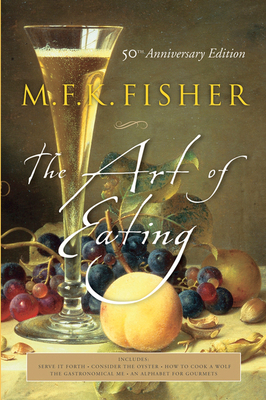
7) The Art of Eating

The Art of Eating is a collection of five of the most well-known works by M.F.K. Fisher, Lady of All Things. Her writing about food is specific and uncomplicated - like the individual bits of a slice of mandarin orange, whole and slick and satisfying. In An Alphabet for Gourmets she offers entries like 'Dining Alone' for 'A' and 'G' is for 'Gluttony.' It is a surprising, whimsical and delicious book. Even serious and pressing topics like hunger during war and loneliness are treated with compassion, frankness, humor and humanity in How to Cook a Wolf (the wolf, of course, is hunger). Written during World War II, Fisher offers solutions to questions of how Americans can nourish themselves and, maybe, prevent their taste buds from dying off. As white America has never really had working taste buds, there is something inherently tragic and courageous in her attempts.

Food writing is a genre that is under-explored by most readers. There are some famous names like Anthony Bourdain and Ruth Reichl, so it's not a wholly ignored section. That said, not many people know of M.F.K. Fisher though they remember watching Julia Child on PBS - and yet these women were friends, they shared concerns about food and cooking and culture with each other and the world. Dig under the top layer of ingredients in any cook book or book about food and you will find life, steamy and simmering. The books in this collection are like a dam in a busy river - both because the book is a door stop, and because Fisher's prose requires a slowing of the mind, of the pulse, of the body. We are required to think with our gullets, to feel the effects of food beyond something like satisfaction. Eating something as simple as a slice of dried mandarin orange becomes an act of creating a story and becoming part of it. This is a worthy addition to any library.

The Art of Eating: 50th Anniversary Edition Cover Image
This book is three inches thick.
The first book by M.F.K. Fisher that I ever read was about the time she spent in Provence before and after the Second World War, before and after her first marriage, before and after having children. Her descriptions of the places and people were respectful and lacking in that golden romantic glow of so many others who decamp to the South of France in attempts to find their souls. She did not seem even to notice a particularity to the light. She learned there to eat. She learned to be alone. She learned to be suspicious and eventually she teaches us how to consider change.

I'm angry that I was not introduced to her at a younger age. Angry that food writing is a thing shunted off to the bare spaces between fancy unused cookbooks or clumsily left somewhere in history section of your personal library. When I was a child at home, food mattered - we learned to taste it, to try new of it, to enjoy it and to seek out nourishment that fed our hearts and our souls and our bodies. That stayed with me. The outside world allows for "I won't like it and don't want to try"and while there is a completely normal component to that, it's not my go-to position on new food or new atmosphere. There is privilege in being comfortable and unhurried in any restaurant situation, and it is one of the few privileges for which I am grateful. I was raised to care about the food that people made; it is of them and they are sharing it with you. 

It was even more powerful to learn to care about the food that I make for myself. This book, along with If I Can Cook/You Know God Can and Super Natural Every Day opened up my kitchen and my personal food stories to me in ways that would never have happened without them. These are stories that I did not know how to tell. I had to hear them first, and then learn to recognize the experience.

Friday, September 23, 2016

6) Jan Morris

Jan Morris is a writer of extraordinary grace, patience, and wit. Her ability to describe place as atmosphere, people and impressions is unparalleled. The 12 books you see in this photo are only a small part of her extensive and global writing oeuvre. Every place, every time, every internationally momentous event that she's written about becomes solidly present, no matter how distant from them I may be.

She no longer writes travelogues, but you can still find new editions of many of her classic works, and, as you see here, used editions as well. Because there are people in the world who do not want them. Which is sort of incomprehensible to me, but my library does benefit from it. There is only one book in this photo that I bought new, although while I was copying the link for the caption, I found another book of hers that I now have to have. (Bookselling is expensive for booklovers.)

Jan Morris is a writer who writes confidently in her own voice, while almost never telling her own story. She notably wrote about her transition in the book Conundrum and addressed it again in the follow-up memoir The Pleasures of a Tangled Life, where stories of family, personal perceptions and discovery are the focus than anything salacious or gratifying to overly curious cisgendered people. Her book was the first place where I read someone specifically addressing the details and rules of femininity. It was shocking. In the skilled hands of a writer of her caliber, though, how could a thorough understanding of the subtle and telling ways in which women and men move differently through the world be anything but?

Hav is the one novel that she wrote. In it, an unnamed traveler moves through the city of Hav, stays in hotels, eats food, meets people and conducts what we gather are interviews all the while sharing local lore, history and odd tit-bits to keep the narrative flowing. It's a city with a history intimately connected to the vanished Ottoman Empire and the Hapsburgs. A city of cynicism and romance and dour music in the air. It sounds kind of awful. I want to go there. Of course, I can't. It doesn't exist. Except in my imagination and hers. 
Travel narratives are a particular interest of mine. I hosted a travel narrative reading group for about a year. It never really took off, but I read some fantastic books! During the planning stages, a co-worker asked if I'd ever read Jan Morris as part of a longer conversation about women writers of travelogues. The beginning of this literary love affair was beautiful and compulsive. She's been an invaluable companion, even in places that are totally unexpected - my love for Steve Rogers is well-documented and reading Manhattan '45 was moving as I kept imagining Skinny Steve learning the patterns of the streets and the piers of the city, as any kid would, especially if he was the type to meet people and maybe get into trouble.

My collection of travel narratives grew on the spines of Morris's books. Her prose style is immediately impressive and her tales unfold like cooling coffee on a lazy morning. Every new-to-me book of hers that comes through Used at the bookstore is like a Golden Ticket or that one doubled-peanut M&M in the bag. 

Back in 2012, I didn't think too much about what it meant that I'd read only 3 books of travel by women, and only 1 of those was by a professional travel writer. The collection of travel narratives in my women-only bedroom library is still dominated by Morris, but is not solely hers. Still. 

Finding them is a journey unto itself. Happily, I do love to travel.

Thursday, September 22, 2016

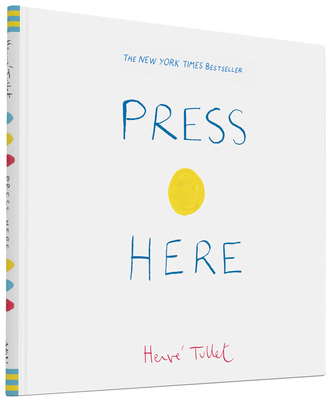
5) Press Here

Children love hearing the same book over and over and overandoverandoverandover makeitstopandover again. One of the big challenges of Storytime is to find books to share with families that will not inspire parents (who are of my people (those who can use the potty on their own) - adults) to tear out their hair (gnash their teeth, claw their own hands, facepalm so hard it leaves marks, etc.). It was a joy to share this book with our crowd. It is surprising in its approach to how readers interact with the pages, and the end of book calls for clapping - lots of it!

Children have these incredible responses every time you turn the page to see what the tapping, tipping, shaking, blowing and clapping have wrought. They are utterly engaged - even the uber cynical 5 year olds are wide-eyed and standing by the end. It is a book that requires understanding of simple colors, numbers, sides and actions to enjoy thoroughly, but does so in a way that isn't overtly educational (Mercer Meyer & Lucy Cousins, I'm looking at you). 

This is one that I read every chance I get. Again. Again. Again! AGAIN!

Press Here Cover Image
The Original, The One That Still Gets Me

When this book found its way into my hands, I was a giddy, squealing very old child for several minutes. And then I put the book in the hands of an equally delight-able co-worker who was also instantly engaged, and so on, and so on, and so on.

Storytime was a mystery to me for the first few months I did it. It wasn't until about Easter of 2012 that I finally felt a kind of rhythm in it: in the routine of choosing books, setting up the chairs, getting activities ready, my co-worker who became my co-heart every Saturday morning and I going through the steps of the morning together - all of that took time to get right and this book really helped it along. Because it is so surprising, and at the same time its genius is readily identifiable. 

This is a book for people who want books to do things that they can see as well as feel. Thinking and talking through what worked about Press Here gave me a way to think and talk about what worked in Storytime and with those questions and answers, I was much better able to build something in that very special place that for a time was extraordinary.

Thanks, Herve.

Wednesday, September 21, 2016

4) Super Natural Every Day

Choosing cookbooks is tricky business. What is the point of buying a recipe book if there are fewer than 3 recipes that you will use/find interesting? The investment is not inconsiderable, so the question is a good one. All of the recipes in this book are vegetarian, and most of them are made really easily. A notable exception to a poached-egg-neophyte is the page long list of "simple" directions for making a poached egg. I truly had no idea.

This book introduced me to dishes featuring cabbage, garlic and chickpeas (such a perfect combination of flavors). There are dishes for every time of day, and they are intended for every day eating featuring ingredients that can be added to or found in a pantry with little strain on the budget. As a person who cooks for one, the portions took some getting used to, but the work was utterly worthwhile. It is also filled with lovely photographs.

Super Natural Every Day: Well-Loved Recipes from My Natural Foods Kitchen Cover Image
Every flavor I want is in this dish right here

I vividly remember making a soup of cabbage, garlic, chickpeas and grated parmesan cheese in a light broth one winter's night. I sat at a drop-leaf table with a broken leg in my set-of-boxes studio apartment and cried. It was the most perfect set of flavors I'd ever eaten, and it was food that I'd made for myself. Like falling in love or holding a purring cat - there just aren't words.

We live in a culture that is shamefully flippant about food. This book and the joy I found within it was the beginning of the most important relationship I think I've had in St. Louis - food. (sorry, bros, but, for real) 


Reading for 21 Sept 2016

Holy Cow! Press Announces First Fiction Contest

Marley Dias started a zine for Elle. #1000BlackGirlBooks founder promotes even more books! Congrats, Marley!

Little, Brown Launches Award for New Illustrators

National Translation Month (who even knew this was a thing?!?)

Tuesday, September 20, 2016

The bells of noon

I love living near churches. They are brick and stone ponds in a neighborhood. Places the sunsets paint everyday and oh, the bells.

My parents were married in a church with a 220-bell carillon. The bells rang at their wedding. The carillon is massive, brick and its sound carries for blocks in Lincoln.

In Chicago, we lived within 1 mile of at least a thousand churches (South Side, amiright?) but I don't remember any bells. Not even from the Catholic church (St. Barnabus, if you must know) that defined our parish. Our house shared a street with the trains, though, so. We still had a repetitive, timed soundtrack to our lives, but it was ... different.

I remember sitting in my apartment on B Street in Lincoln, realizing that I could hear the bells from ... somewhere. When I moved to St. Louis, I reveled in Sunday mornings, and still love the hustle and the bustle of other people going to church, of bells on the holidays reminding me to breathe slowly for a moment and inviting a blessing for the celebrants.

Here we are offered hourly serenade.

The noontime bells just filled my open window with something more joyous than 12 on a Tuesday might seem to warrant.

A reminder of the sacredness of time? The power of focus energy in a community? The privilege of clocks?

All of this, I think, and more.

The bells drew this forth, after all.