Wednesday, October 12, 2016

Finding what troubles me in Trace

#40days40books entry 24

Lauret Savoy is a geologist of mixed heritage. Her book Trace: Memory, History, Race, and the American Landscape is a study in finding the stories that wind, water, time, and discomfort have eroded. She begins with a memory of traveling as a child to the Grand Canyon. The beauty of the landscape and the sting of casual racism in the memory of a woman who once was seven years old set the tone for the whole book.

Her specificity and understanding of how to tell the story of the land evoke clear images of places I've never seen. She travels along the border with Mexico and interacts with a man on patrol there. She and a friend tour a plantation in South Carolina and have questions about the absence of enslaved people in the narratives shared about the house. In the desert she goes looking for an army base and finds remnants. Ragged threads and bits of stories put together to work out the layers of her life before, the layers of the people who made her, who came before her, who lived, and left traces of themselves in the land. It takes sharp eyes and ears to pick them out, and she has both.
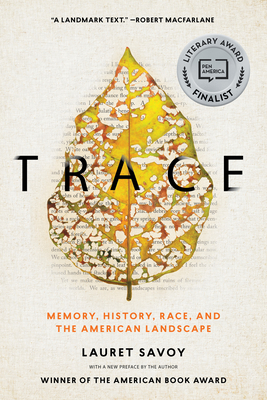
Trace: Memory, History, Race, and the American Landscape Cover Image

I grabbed this off the new release shelf the day that it came out. The cover is intense and intriguing, the subtitle is inviting and the author's background in geology was like a door opening up to some unimagined library. I love how scientists write about the world. Their specificity and ability to see the story of a place, of a tree or insect or weather pattern is captivating. And I wasn't disappointed. There is no place in this book for me to put my own memories over any of her landscapes - they are so sharp and clear and rooted that all the imaginative work reading this is in keeping up with her.

And it's hard work. There is loss and erasure. There are vast scopes of time, human and geologic, to cope with. There is the personal damage of racism, the psychic amputation of foiled creativity, the injustice of the forgotten. No landscape can lie about its origins in her gaze. I get poetic talking about the book, and that is how it should be.

This was also the first book I reviewed for WomenArts Quarterly.

People of color travel. People of color write. They photograph, draw, science, music, food, paint, sculpt, plant, shape, sew, etc. So where are the travel books? The answer is too obvious to warrant the question, and yet - we ask.

There are growing movements of people working to encourage change in the travel industry and in the world. Here are a few:

Nomadness Travel Tribe
TravelNoire
Vagrant Anonymous - in particular Decolonizing Travel
Bani Amor - also on twitter

#40days40books list

Tuesday, October 11, 2016

Hair and the processing of privilege

#40days40books entry 23

Women's hair is big business and big fashion. There are not enough pages in the world to deconstruct the relationship between our dead scalp strands and ourselves. These two books are part of what happens when women take each other seriously and start to look at how hair molds and defines us and our journeys in the world.

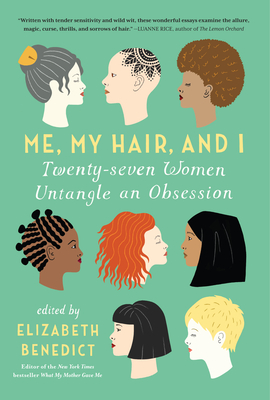
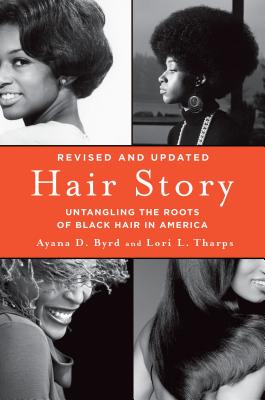
Me, My Hair, and I is an anthology of 27 essays by women from a variety of backgrounds. The essays range from personal to political, and from dye jobs to pubic hair. Hair Story is a more historical work that chronicles Black Hair in America from the time of slavery to the present. The 2nd edition was published in 2014.

Both books are thought-provoking, intimate and engaging.

Me, My Hair, and I: Twenty-Seven Women Untangle an Obsession Cover ImageHair Story: Untangling the Roots of Black Hair in America Cover Image

I grabbed Me, My Hair, and I off of the galley shelves in a flurry of passion. I love to listen to women talking seriously about hair, and how wonderful to find a book whose cover promised an incredible range of voices and experiences.

And a white lady with dredlocs. You know.

At first, I had decided not to read that essay. And then, after being blown away by the politics and culture exposed and discussed so eloquently in some of the other essays, two things happened. I read a review of the book that pointed out the abundance of women of color on the cover as opposed to their words in the book. And then I heard Dr. Adrienne Keene's interview on Another Round, in which she talks about her hair for a moment.

Suddenly, clarity.

There are no veiled women in this book. Or Native women, or women discussing the struggles of Asian hair, and the Black women write about the politics and pain of hair only. And that one about the dredlocs? Listen. I read it and almost threw the book across the room.

I ordered Hair Story the next day. I found it because in my quest to find Black Women Travel Writers I found Lori Tharps (and Lauret Savoy.)(and that is all)(which is a conversation I will have later) who co-authored the book. The bibliography is like a candy store of information.

It is important that the things women do to ourselves to exist in the world are acknowledged as having meaning. The business of hair is huge, it has far-ranging cultural weight, it has environmental weight, and it isn't going away.

Benedict's book shares important stories, and you do have to deal with the blanket of white privilege to get at them. It's sticky and gets everywhere. Looking beyond privilege and discomfort with it is work. Seeking out stories in different voices means understanding the range of difference in voices. It means listening without response. It means being uncomfortable with ourselves. It means that we look harder when hair is used as a tool of abuse. It means we stop apologizing for the women who appropriate.

White women are not taught that we are complicit in the culture of oppression. So we have to learn to identify it. Naming for each other the places where we must do better is part of that learning.

Meanwhile, have this from the Guardian. It is glorious.

#40days40books list

Sunday, October 9, 2016

Shh! We Have a Plan or the fragility of bad ideas

#40days40books entry 22

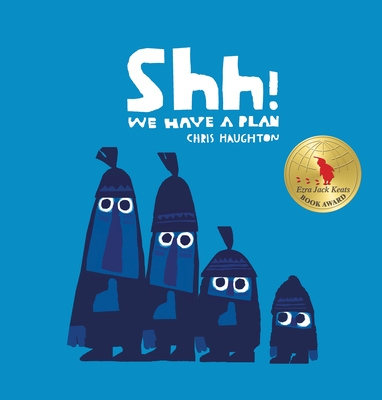
Shh! We Have a Plan is Chris Haughton's cautionary tale about the dangers of bad ideas and over-reaching.

Four un-named characters wearing hats spy a bird and while one of them is interested in greeting the flying creature, the others urge silence, saying that they "have a plan" to catch it. The plans fall apart, of course, each one more ludicrously than the last.

The littlest one never varies in kindness, kindness and stillness which are repaid handsomely by the birds during the course of the story. The hunters, though, they do not fare quite so well, never learning the power of kindness and friendship.

The images are bright and minimal, and carry the story along with ease and interest.

Shh! We Have a Plan Cover Image

Storytime is the place where I get to make all the goofy mouth noises. This book is an enormous amount of fun to read because there are not so many words to read upside down and backwards (think of me when you next read Dr. Seuss). Also because as a reader, you get to make your voice loud and soft, tense and kind, hopeful and defeated. It's so fun and the kids never don't love it.

The humor in it is the kind of thing that seems to translate well for children. The people who are laughable are, indeed, doing something that is wrong, and that we know is wrong. We know it because an alternative has been presented - one that is kind and quiet and likely to work. All of the plans the taller three characters have involve trapping the bird. Kids are thrilled when they end up falling out of trees, over each other and into water. They gasp at the crowd of birds that surrounds the littlest one whose only attempts have been at gentle friendship.

We can only hope that the three taller characters learn from their friend that saying hello and offering a bite to eat is a much better way to interact with the world than trying always to catch a thing. Simple community building with a good dose of actually funny humor.

#40days40books list

Shifting out of first gear

#40days40books entry 21

You have to know. To understand. Nothing happens in a vacuum.

On August 9, 2014 everything changed. The World Changed. Every word written here, every book listed, every reason for this list, all of it happens in a world that is not what it was before. Before Ferguson. Before Gamergate. Before all of the conversations that stripped complacency from awareness and left me grasping for some kind of sedative that would keep me from falling back into the abyss, but that had room for laughter and romance and silliness. And, yes, those are resistance and they are needed. Reading quiets the storm in my head. Gives me a map, a way toward something better. There are whole lists of books for anyone interested.

Here is the shape of my on-ramp:

Bad Feminist is a collection of essays that catapulted Roxane Gay into think-piece stardom. Her social media presence is inimitable and intimate and her essays are no different. They range from the questions that women have about enjoying pop culture in a world where all pop culture uses our bodies as objects, sometimes violently, to just how competitive a person can get about Scrabble. Her work is complicated and wide-spread. She sees much and writes with the awareness that brings her. It is not an easy collection. There is rape and there are terrible repercussions of rape. There is discomfort and bad decision making. All of the things that make adulting such a you-tube phenomenon.

Unspeakable Things comes from a young woman who brings something utterly troubling to the table: a picture of life on the ground floor of revolution and exactly how full of shit it is. Laurie Penny writes about the realities of sexual politics in activism and the presence of rape culture in the Occupy movement. She writes about the effects of the recession on the men in her life. She writes about the growing awareness of young men that the patriarchy doesn't care about them anymore than it cares about women. She, also, writes about rape.

The thread that binds.

Bad Feminist Cover ImageUnspeakable Things: Sex, Lies and Revolution Cover Image


Roxane Gay's book came out in August of 2014, Laurie Penny's in September. They signaled the beginning of a different kind of feminist bookshelf - one explicitly connected to the world of pop culture and social media. This is not to say that feminists and social justice activists have not used social media for years - quite the opposite, in fact. Publishing and bookstores in the white majority main stream book world are finally catching on. It takes a while. The status quo is heavy and persistent. Or so we are told.

More than one person I talked to read bits of these books and put them down, saying that it wasn't like they disagreed with anything in them, but that the conversations are 40+ years old and shouldn't we have stopped having them by now.

I overheard a deeply privileged woman expressing a common theme among white ladies: Gay's feminism is fine, but too much in the world of pop-culture.

Penny's book was criticized by a friend of mine for not seeing how dangerous the world is for women of color. She pointed out that the kind of revolution that many white activists think they are advocating for puts many marginalized people in grave and immediate danger.

We do not get to choose the revolutionary narrative. It is not our right. Or our privilege.

These books were the place I began. I am working to read more, to think more, to be unwilling to turn off my brain in order to laugh or be transported. I like my brain. It thinks things. Turning if off or walking away from is simply good practice for collusion with oppression.

#40days40books list

no more lady novels for me, thanks

#40days40books entry 20

Somewhere along the way, I realized that I don't read a lot of fiction written by women. Specifically I don't read romance novels and I don't read domestic fiction.

There's a reason.

What I mean by 'lady novel' and 'domestic fiction' is this story line: Amy and Betsy have been married for 14 years and everything seems perfect. Until Now. A family tragedy opens old wounds and Amy struggles with a dark secret that threatens everything she's worked for. And what happens with Betsy has to confront her own doubts and questions?

The dark secret is: adultery, incest or rape (sometimes all of them). The doubts are usually sexuality or trust. The family tragedy is either a terminal illness or the death of a child.

You've read this book. You've read a bajillion of this book. Someday I would love to write about how global on-line etailers have directly contributed to the rise of this specific kind of book.

For now it is enough to say: enough.

As a woman who writes things and who loves to support women who write things, I read women's writing. Fiction, non-fiction, poetry, blogs, essays, tweets and listicles.

But not this. Not this limited, classist, homophobic, sexist, lazy narrative promoting nonsense.

There are books that do not, by the way, conform to this obnoxiousness, even as they look like they do.

Everything I Never Told You by Celeste Ng is a story about a family reeling from the death of a child. The dead girl's parents and older brother struggle to face what that means in their own ways, and that involves dredging conversations out of long-held silences. There is adultery. There is racism. There is a kind of internalized sexism. There is hero-worship of the golden boy. But it works. It is never easy. It is never convenient. It never panders to privilege.

And it could be the norm.

Until then, I will stick with my barricaded ladies and Irish internal monologues.

#40days40books list

Friday, October 7, 2016

The Odyssey takes its shape


#40days40books entry 19

The story of Odysseus is part of a larger cycle of epic tales of warriors, travelers and the ancient world. Odysseus left home to go to war. 20 years later he returned home. This is the story of that journey.

Telemachus, at age 21, leaves home to find news of his father.

Penelope, presumed widowed after 20 years, is occupied outwitting her impertinent and dangerous suitors.

Image result for the odyssey homer vases

Okay. I own eighteen translations of this book. They are all in English and most of them are in verse. I had to make a decision early on in order to control the number of copies that would find their way into my home.

What happened is NaNoWriMo 2011. That year's novel idea was based around the production of a mini-series of The Odyssey starring Sean Bean. It hadn't been quite ten years since Troy was released, and it seemed a good source for varied and challenging storytelling. Word counts are at the heart of NaNo and it's tough to write when you have no idea what you are going to write about, yeah? So. Follow an actor, a character, a scene, a difficulty with translation, Athena showing up and messing with things - all of those provide enough prompt to get one or two thousand words out of. Nothing has been done with the work since then.

Except this - 18 translations of The Odyssey. 8 translations of The Iliad and 5 of The Aeneid (because folks usually translate these three as a set, so why not?).

Penelope is forever my favorite character - she of the woven barricade and sharp business skills. Telemachus is deeply interesting and at a crucial place in his life. Odysseus is kind of a dick, and an excellent storyteller. There are days of conversation in that connection. Proteus, Nausikaa, Kalypso, Kirke, Menelaus, Helen and Nestor all hold the edges of this crazed quest in shape.

Different translations and verses outline the people differently - something I find endlessly fascinating. The story has lived for so long that any attempts to force it into one or another shape are constantly thwarted. Translations can only force so much, something I find deeply satisfying and troubling with every read.

So far the Cowper translation is my favorite, but as it is out of print and impossible find - the Fitzgerald translation is my favorite that is on my shelf.

At some point, I'll share the catalog of that collection with commentary.

Not yet, though. This is about what happened to my library on account of Left Bank Books.

It's a map, not the journey. Not as yet.

#40days40book list

The usage of a coffee table

#40days40books entry 18

Monasteries and Monastic Orders: 2000 Years of Christian Art and Culture is a survey in photos, maps and explanatory essays of monasteries in Europe and the orders that built them. It is organized chronologically by order. Within every order's section there are 2 to 4 pages devoted to each monastery and its landscape. There is a section for women's orders. Not beguines, but that's hardly surprising.

The focus is entirely academic and artistic. Organizing the book chronologically allows the author to frame developments in architecture, decoration and communal living as they follow one from the other. The text is informative and rich in fact, of course, although not without humor and a real sense that the audience is someone who is interested in understanding and can read the imagery and design choices in the photographs. It is a thoroughly gorgeous book.
Monasteries and Monastic Orders: 2000 Years of Christian Art and Culture Cover Image
Opening this feels like walking into church

This book is almost exactly the size of the coffee table. And the coffee table is not small.

There are always books that sell much better than anyone could have predicted. We're always surprised. Partly because, as said, no one predicted it. That was the case with this one. Everything about the experience of reading this book is appealing. The colors on the cover are muted and invite contemplation. The book weighs more than 8 pounds. So bringing it home on public transport was fun.

I used to go and visit it on random Sundays off. Because I knew how to Sunday afternoon in St. Louis.

Itinerary for a Winter Sunday in early 2014:
Brunch at Mokabe's unless you are feeling flush and have a new book in which case brunch at Cafe Madeline.
Walk in the park. Pick a park. There are a gagillion.
Bus and train downtown - leave the train at the convention center and stroll back to Central Library.
2pm concert at the Cathedral with a small crowd of 40. Let the carving and the storytelling of the cathedral and the music shift your focus and astonish your senses. Have faith for a moment or two. Breathe differently the reverential air and let it be in your body.

Walk outside.
Read the buildings. Read the sunshine. Read the air and the sidewalk and the sounds of the city.
Feel your footsteps as lines of rhythm adding to history. Go slow.
By the time you get to Bridge, the brightness will have mellowed and your sight will have moved back into this century. The darkness of the bar will soothe.
Order something dark and spicy. Ask to have it in a pretty glass.

Head through the door into the bookstore - rather the opposite of heading into the Wardrobe - it is all golden wood and sunshine and open space.

Put the beer down on the counter - you need two hands for this.
Head to the Architecture section and gently, oh so gently, slide the book off the shelf.
Cradle it as you walk back to the counter. Remember - this book is not lightweight.

Be silent as you stand over the open pages. Do not spill your beer. Do not gulp it. You are surrounded by the work of work. It is sacred and deserves care.

Walk the corridors and colonnades of centuries gone charming and culture made oppressive. Consider the quiet of a faithful life, the struggles and work and rites and lights. Remember the air of the cathedral you just left and push it forward four hundred years until your lungs hurt and you are not sure if it is the beer clouding your awareness or the book.

Stay there. Until your eyes see the dust moving in sunbeams trapped in photographs thousands of miles and several years away. Until you hear chants you cannot know and the shuffling or striding of feet under robes. Move through the centuries as you turn the pages. Move around the Continent and up and down naves and around chapels. Say prayers in a voice that is not your own.

Take a breath.

Close the book.

Put it back, and go read the world anew.

My Sundays look very different now. The counter in a sun-filled space is replaced with a coffee table at home. I am more likely to have a glass of water than a glass of beer and do not need to travel so far to scour the distractions of modern life from my eyes. But the book remains. And transports. Every time.

#40days40books list